
Angelica Mesiti, The Swarming song
Angelica Mesiti, The Swarming song

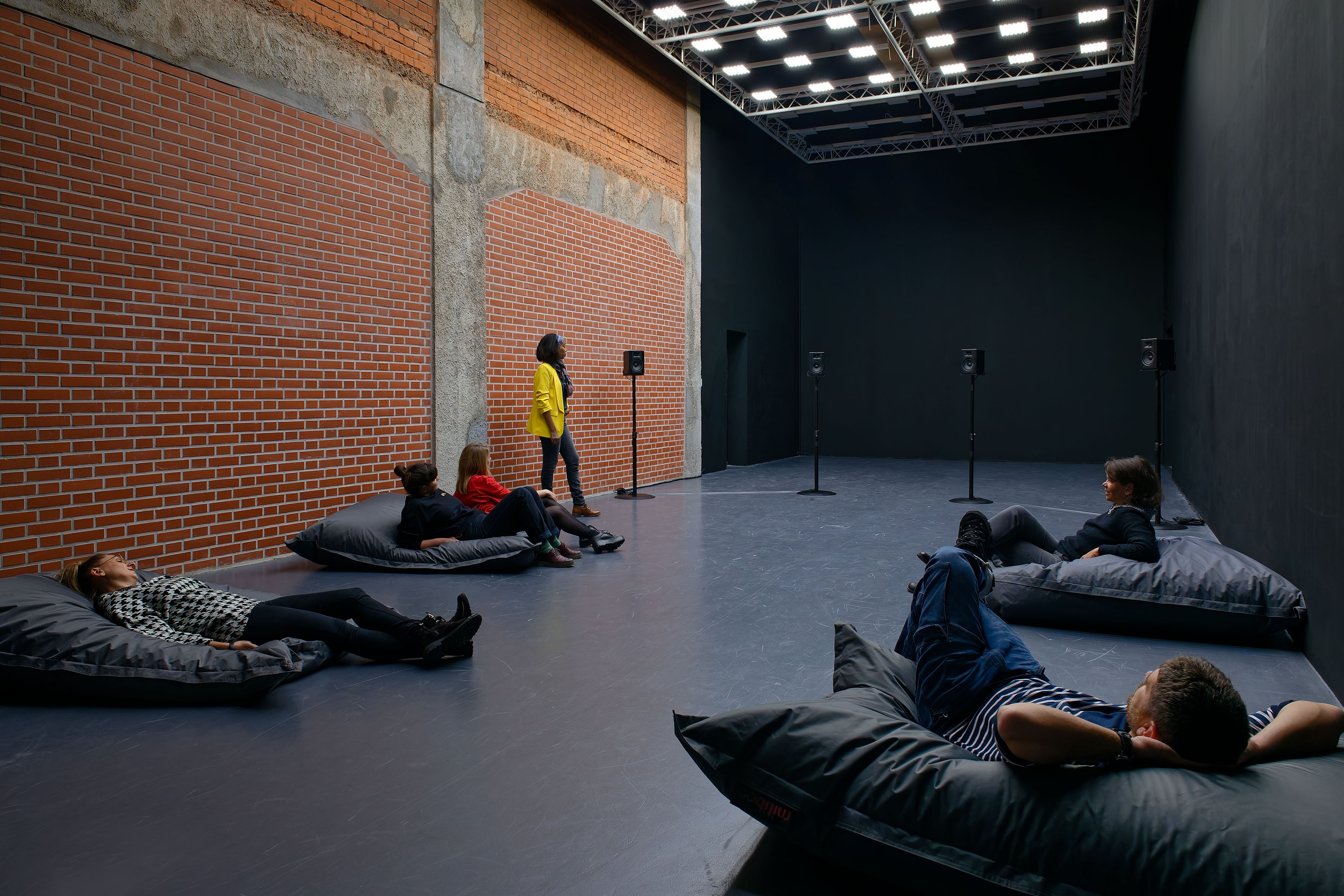
Angelica Mesiti has based The Swarming Song* on a seventeenth-century score in the collections of the University of Edinburgh. Entitled Melissomelos, or Madrigal of the Bees**, this four-part vocal composition was written by Charles Butler (c. 1571-1647), an English music theorist and beekeeper, nicknamed "the father of English beekeeping", and was published in his 1634 treatise The Feminine Monarchy.
In it, Butler attempts a musical transcription of "piping", the fascinating, intense sound, punctuated by rapid pulses and silences, that is emitted by the new queen bee to initiate swarming - a call to which the entire hive responds. In his hands, this animal song becomes a score where life and music enter into dialogue.
Angelica Mesiti has taken this work and given it a contemporary reinterpretation. By modifying the original score, she has created a new version, recorded at Edinburgh University's Reid Concert Hall in 2021, with a female soloist guiding a four-voice choir. The whole is broadcast into the space as an immersive installation, inviting deep, enveloping listening.
The Swarming Song is part of the artist's wider approach, which examines non-verbal forms of communication, questions of translation between different language systems, and the sensitive links between humans and non-humans. By drawing on ancient music, historical research and the social behaviour of bees, this work weaves a fertile dialogue between the past, nature and contemporary art.
Angelica Mesiti was born in Sydney, Australia, in 1976. She now lives and works in Paris. Her work combines video, sound, performance and installation to explore unspoken modes of expression, often derived from collective traditions and narratives, and their forms of transmission. Representing Australia at the Venice Biennale in 2019, she is developing a sensitive practice that questions the way in which the body, the voice and the environment can convey what escapes words.
* Swarming song is a particular moment in the life of a beehive, when a group of bees leaves the overcrowded colony with the oldest queen to found a new hive elsewhere.
** A madrigal is a short, rather polyphonic vocal composition without instrumental accompaniment based on a poetic text expressing a fine, tender or gallant thought.
Dates
Opening periods
from Friday 17 October to Sunday 1 March
Practical information
Group service
Art and shows
Rates
| MINI | Max | Additional information | |
|---|---|---|---|
| Free of charge | 0 | Every Sunday, under 18s, school and similar groups, students, Carte Avantages Jeunes, artists (Agessa\/Maison des artistes), Friends of the Frac, Friends of the Consortium, etc (see frac website). | |
| Basic rate | 5 | ||
| Reduced rate | 3 | Large families, over 65s, Education Pass, Accompanying person with Avantages Jeunes card, Ginko monthly subscriber | |
Means of payment
Credit card
Cash